
Papillion Directory Shelves
The strongest confirmed shelf for a Papillion directory is the Omaha Public Library Genealogy and Local History collection. It holds Bellevue/Sarpy County volumes for 1963-1989, 1991-2007, and 2009-current. Those labels matter: search Papillion, Bellevue, Sarpy County, a street, and a surname separately. The official collection page did not identify the publisher of these Bellevue/Sarpy volumes, so a publisher should not be assumed from a familiar directory brand.
| Collection | Years | Where Held | Access |
|---|---|---|---|
| Bellevue/Sarpy County city directories | 1963-1989; 1991-2007; 2009-current | Omaha Public Library Genealogy & Local History | Library collection; confirm volume availability |
| Bellevue Papillion Sarpy County directories | 1885, 1961, 1980, 1981 | Nebraska State Genealogical Society | Holdings listing; contact the library for access terms |
| Sarpy County Museum newspapers | Varies by title; Papillion Times 1900-1988 | Sarpy County Museum | Research request by email |
| Papillion Times microfilm | 1937/1940-2003 | History Nebraska | Institutional microfilm access |
These runs do not prove that every street, every year, or every Papillion household appears. The Nebraska State Genealogical Society holdings supply rare early references, while the Omaha shelf supplies the broad modern run. Record the volume year before drawing any conclusion from an absence.
The Omaha Public Library city-directory collection is a practical starting point for a Papillion directory search.
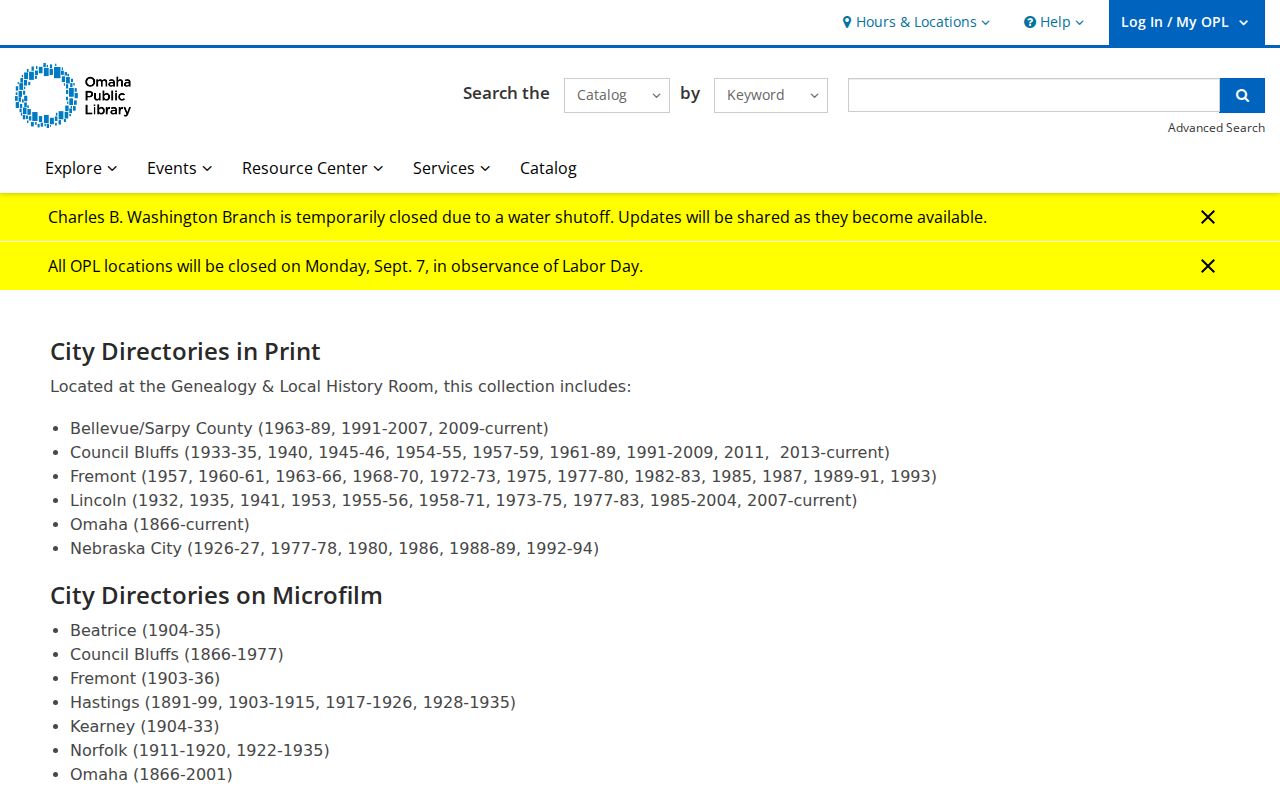
The library collection gives the year-and-place context needed before a surname result is treated as a Papillion lead.
Papillion Directory Gaps and Census
A dated directory is most useful between census releases. Pair entries with the federal censuses of 1900, 1910, 1920, 1930, 1940, and 1950, the latest released federal census in the research. A directory year can show an address or occupation change in the long interval between those enumerations. For decades before the fuller late twentieth-century run, the 1885 holding, county records, newspapers, and family sources may carry the trail.
Start a timeline with the exact volume year, spelling, street form, and household notation. Check the front and back matter for new-building notes, street information, and the abbreviation key. The Omaha Public Library property-history guide also warns that directory years can leapfrog several years. A missing name may reflect a move, an unlisted telephone, a different spelling, or a volume gap. It does not settle the question by itself.
Note: Census and directory records describe people at different moments, so preserve the date attached to every address rather than merging the evidence.
Papillion Directory Archive Routes
The Sarpy County Museum research archive reaches back to 1854 and accepts research inquiries by email. Its listed leads include district court, marriage, naturalization, town, cemetery, church, school, physician, and yearbook material. Newspaper holdings can help explain a directory disappearance or identify relatives who do not appear in a short household line. The museum page shows Papillion Times 1900-1988 and a separate printed date entry that appears internally inconsistent, so confirm that item with the museum instead of correcting it by guesswork.
For digitized historical objects, the Sarpy County Historical Museum collection in CONTENTdm provides general and advanced search, a collection selector, and date-from, date-after, date-before, and date-on choices. It is public to search, but rights remain with the museum. The separate Sarpy County Historical Society collection traces the society's 1934 formation in Papillion and holds two reels of early land, election, church, biography, and genealogy material. Neither route is evidence of a complete directory run.
The digitized Sarpy County Historical Museum collection offers a useful visual bridge for Papillion place names and institutions.
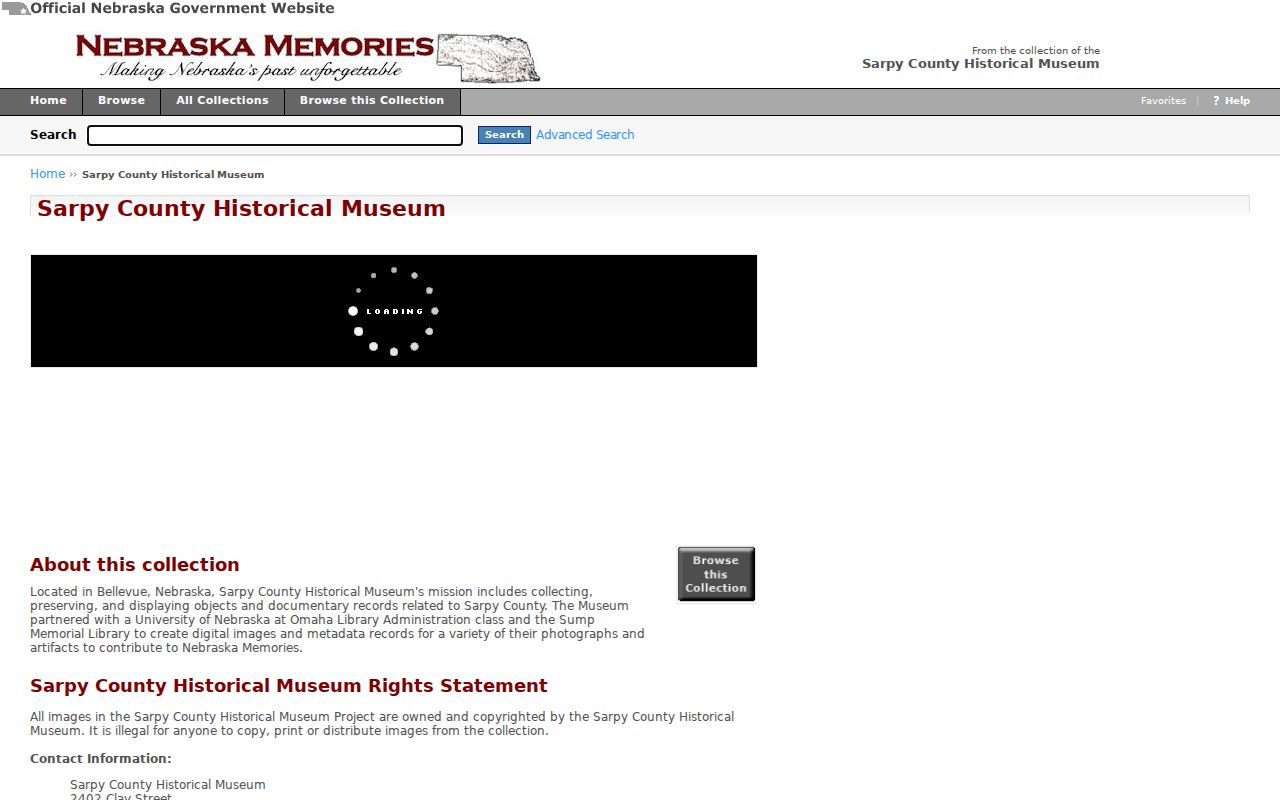
Dates and place names found with digitized photographs can be compared with a city directory without claiming that an image establishes a household address.
Reading Papillion Directory Lines
The Omaha Public Library property-history guide documents the types of information a directory may contain. An entry can give a surname and given name, spouse or household notation, occupation or business, and address. Some volumes supply an owner or renter mark, and later reverse directories can list an occupant from an address. The marks and abbreviations depend on the individual volume. No Papillion sample page was captured, so no local person, symbol, or publisher imprint should be invented.
| Name | Surname and given name, with spouse or household notation where the volume uses it. |
|---|---|
| Work clue | Occupation or business may appear, but its format varies by volume. |
| Address | A dated address association, not proof of present residence. |
| Owner or renter mark | Use only if the volume supplies a key; occupants are not always owners. |
| Reverse line | Post-1900 reverse directories may run from address to occupant. |
- Criss-cross directory
- A reverse directory arranged by address, used to find the occupant line for a house or street.
- Householder index
- An index centered on the household or named head, useful when a surname is known.
- Abbreviation key
- The volume's explanation of shortened labels and symbols. Read it before interpreting a notation.
Note: A directory records an association at publication time; a deed or parcel record answers a different ownership question.
Papillion Library Names Database
Papillion Library's database list adds sources that fill gaps around these volumes. Ancestry Library Edition is available in the library and includes census, vital, photograph, newspaper, story, and map material. Heritage Hub supplies obituary and death-notice coverage from 1704-current with original images through the stated library-card access. MyHeritage, NewsBank, and Omaha World-Herald material are separate tools with their own terms.
NewsBank includes Papillion Times material and the Omaha World-Herald collection covers 1983-current with full-color pages. A newspaper notice can anchor a move, death, business, or school event after a directory result has suggested a name. It should be dated and compared with the entry, not used to fill a missing date by assumption. Telephone listings can also fill a gap, but a phone listing only supports a number-and-address association.
Papillion's 1876 Record Shift
Papillion became Sarpy County's seat after a special election moved the courthouse from Bellevue, effective January 1, 1876. That change helps explain why courthouse, clerk, recorder, and court trails converge in Papillion even when an older family story points to Bellevue. The record path becomes more layered across time: hand manuscripts and land entries, courthouse volumes and microfilm, then city directories, newspapers, parcel databases, and web portals.
- 1857: Sarpy County was organized from Douglas County.
- January 1, 1876: The county seat moved from Bellevue to Papillion.
- 1885: A Bellevue Papillion Sarpy County directory is listed by the Nebraska State Genealogical Society.
- 1963-1989: The confirmed Bellevue/Sarpy directory shelf begins its substantial documented run.
- 2009-current: Omaha Public Library lists the most recent confirmed Bellevue/Sarpy run.
The Papillion Area Historical Society preserves local context for place names. Its history tells how the group was founded in 1979 to save the Sautter farmhouse, then acquired the Portal one-room schoolhouse in 1995. Both landmarks are near the city library on Washington Street, a useful anchor when an older directory address needs neighborhood context.
The Papillion Area Historical Society connects directory-era place names with local preservation work.
Local landmark history can clarify an old reference, but the directory volume and its date remain the primary evidence for a household line.
Papillion Archive Inventory
History Nebraska RG209 is the county-wide offline bridge for periods a directory volume does not cover. The finding aid spans 1857-1983 and describes county officials directories from 1869-1904, medical registers from 1878-1915, the 1876 Sarpy census, 1868-69 precinct voter registrations, marriage and naturalization material, tax records, and surveyor plat maps. Its 71 microfilm reels and boxes can move a search from a surname to a county record series.
Use the finding aid as an inventory, not an online name index. A collection description does not mean every record is digitized or open at a click. For a historical household, the archive's census, tax, plat, marriage, or voter material can confirm a date range that a directory entry only suggests.
Tracing Papillion Directory Households
A household trail works best when each source has a separate role. Begin with the earliest confirmed directory line, then move forward through available directory years. Record the spelling, address, household notation, occupation, and every move. Compare those dates with a census year, then use newspaper, obituary, cemetery, marriage, naturalization, probate, or tax sources only where they fit the gap. The method keeps an occupant clue separate from title, kinship, and present status.
- Locate the surname in a dated Papillion, Bellevue, or Sarpy directory volume.
- Copy the entry exactly and photograph or note the abbreviation key if the volume permits.
- Follow the name into the next available directory year, watching for a different street spelling or house number.
- Pair the interval with the closest released federal census and compare household members.
- Use an obituary or museum archive to test whether a disappearance reflects a move, death, or a coverage gap.
A reverse directory can show an occupant at an address, while a parcel or deed route can address ownership. For a modern street-by-street question, use the Papillion Street Directory rather than stretching a historical volume beyond its date.
Papillion Directory Limits
Directory evidence is selective and dated. It can omit a household, use a prior name, print an old address, or reflect the editorial choices of its publisher. A volume does not establish present residence, ownership, identity, or a complete family group. The owner or renter notation must be read from that volume's key, and an occupant should never be relabeled as an owner without a deed or parcel record.
When the shelf does not answer the question, use the documented fallback chain: library staff and databases, a Sarpy County Museum research request, History Nebraska microfilm or finding aids, then the relevant county custodian. Name a year and collection when asking for help, rather than relying on the word “old.” Careful dates, original spellings, and record labels make a Papillion directory far more useful than an undated name list.
Note: Historic collections can contain restricted, incomplete, or copyrighted material, so confirm access and reproduction rules with the holding institution.